
Program Overview
The National Institute of Development Administration’s (NIDA) Accelerated MBA program (AMBA) is designed for those who wish to pursue a Master of Business Administration degree to enhance their potential in all areas of management. The goal is to produce a new generation of professional executives to the international level with teaching in English from the most PhD faculty in Thailand.
Program Introduction
Program Introduction by
Current Accelerated MBA Students
Program Structure
| TOTAL REQUIREMENT 42 Credits | Number of Credits |
|---|---|
| BASIC COURSES | 6 |
| CORE COURSES | 15 |
| MAJOR / ADVANCED COURSES | 18 |
| INDEPENDENT STUDY | 3 |
| TOTAL REQUIREMENT | 42 |
Course Descriptions
This course is aimed to provide contents and teaching activities that focus on the integrated skills of listening, speaking, reading, and writing with particular emphasis on academic writing. Students will also work in small groups, practicing paper presentation techniques, précise writing, and research writing.
This course studies microeconomic and macroeconomic theories for the purposes of applying theories for decision-making and business planning. It includes analyzing economic cases from many countries by studying the relationships of leading economic indicators. It also includes the topic of BCG Economy.
This course presents the study of statistical theory and quantitative analysis for use in business decision-making: topics include the measurement of numerical data, sampling distributions, confidence intervals, hypothesis testing, ANOVA, correlation, simple and multiple regression models, and selective topics in quantitative business analysis. In addition, there is a focus on being able to present analytical findings to senior management. It also applies the theories to the BCG Economy.
This course offers theories and principles used to study behavior in an organization at the individual, group, and organizational levels. It is the study of human resource management, which includes recruitment and selection, training and development, developing positive employee behavior through motivation, and employee retention.
This course offers a comprehensive study of marketing philosophy and concepts, marketing plans, marketing strategy for business development, market opportunity analysis, evaluation of the market attractiveness, determining marketing programs, and controlling business execution to maximize effectiveness.
This course studies the principles and issues in utilizing accounting information in business management; an analysis of the roles of accounting in product costing, costing for quality, budgeting and profit planning, reporting, monitoring, performance evaluation, and organization control. It also includes the role of financial and quantitative information in making effective, non-routine managerial decisions.
This course teaches students to develop a framework for financial analysis and management and is the study of the long-term management of capital and assets, short-term and long-term financing, a company’s capital structure and dividend policy, and the cost of capital.
The course is an introduction to the management of production and service operations systems, problem analysis, processing controls for both quantity and quality and an examination of the concepts and principles of operations management for both manufacturing and service organizations.
This course provides a comprehensive macro-environmental at the global and regional level for an effective business setting. It also discusses spotting opportunities and legitimizing business to become a leader in the industry. The focus also encourages local business to shift its paradigm to become a global enterprise.
A Capstone course that integrates all functional areas of business administration with practical application to realistic business problems, strategic management processes from the corporate and departmental levels, and strategic implementation, including corporate design, control systems, and resource allocation. Prerequisites: AB.6100, AB.6200, AB.6300, AB.6400, AB.6500
Since big data promises to turn business data into actionable information, this course will cover a comprehensive analysis of various data mining tools and techniques in the context of most common business applications, such as sales, marketing, and customer relationship management. These data mining techniques include data manipulation, data exploration, pattern recognition, Neural Networks, Decision Trees, Cluster analysis, Sequence analysis, Association Models, Two-stage modeling, and predictive modeling etc. The focus of this course is hands-on learning regarding how to use non-statistical algorithm-based) techniques to solve business problems.
Teaches integrated marketing communications plans, the role of marketing communications and marketing plans, marketing and communications objectives, and communications budget planning. Focuses on the major characteristics of the communications mix elements : advertising, direct marketing, public relations, publicity, sales promotions, and personal selling; also focuses on the evaluation of integrated marketing communications plans.
This course covers types of securities, sources and types of information used in investment analysis, methods and principles of investment decisions, and basic principles and methods of securities and portfolio management for personal and institutional investment
This course will provide students with the theories, concepts, and analytical frameworks that are fundamental to understanding business management. Specifically, this course is designed to enhance students’ understanding of the role and responsibilities of management, and to increase their expertise in a variety of management functions of a firm. This perspective and these abilities are essential for all managers, whether they assume the responsibilities of a manager or pursue a career as a functional or technical specialist. This course will also show how students’ experiences and other courses are relevant to the life of a manager.
This study includes an independent, advanced-level investigation of businesses, including analyzing symptoms, problems, and causes, and includes a business audit and a business plan integrating various functions in business Prerequisite: AB.6100, AB.6200, AB.6300, AB.6400, AB.6500 (for students in plan 2)
Qualifications of Applicant
- Applicants must hold a bachelor’s degree in any field from accredited Institutions and have a TOEFL score of 500 PBT, 173 CBT, and 61 iBT or IELTS score of 6.0 or NIDA TOEFL ITP score of 500 or NIDA TGAP score of 500
- Applicants who are native speakers of English or who have completed undergraduate studies in English with 5 years prior to application
Note: Applicants who would like to EXEMPT registration for the English language course (LC4004: Advanced Integrated English) must follow these criteria:
- Applicants must hold a bachelor’s and/or master’s degree from an international academic institution within the past five years before classes begin; the applicant must obtain a minimum cumulative grade point average (GPA) of 2.75 from their bachelor’s degree and 3.25 from their master’s degree, or
- Applicants who are native speakers of English are required to have a residence and permanent residence in an English-speaking country, or
- Applicants must hold a TOEFL of 79 for the internet-based test, or 550 for NIDA TOEFL ITP. For IELTS, the minimum score is 6.5. Also, the periods of validity of the test score are 2 years until the first day of the fist semester. (TOEFL and IELTS score comparison based on https://www.ets.org/)
- Applicants who are exempted from enrolling in the English language course (LC4004: Advanced Integrated English) must request it before the first semester. If the applicants request after enrollment in the English language course, it will accepted in case the grade is not shown. Thus, if the applicants receive the grade of the English language course, the exemption would not accepted.
1 photocopy of an official transcript
2 recent photos (1″ size)
2 letters of recommendation
(The letters must be sent directly to the university by the evaluators who know the applicants academic and/or work)
1 photocopy of Identification card
1 photocopy of result of TOEFL IELTS/NIDA TOEFL ITP/NIDA TEAP
1 statement of purpose
Fees and Expenses
Application Period
Admission Schedule Academic Year 1/2026
| AMBA Program #14 | |
|---|---|
| Admission Schedule | The 1st Round |
| 1. Application Period Download Online Application Click here! | Now – November 30, 2025 Now – November 30, 2025 |
| 2. Interview Exam Announcement | December 4, 2025 |
| 3. Interview Date | December 8-11, 2025 |
| 4. Result of Interview | December 19, 2025 |
| 5. Pick up Registration Form | December 19-24, 2025 |
| 6. Student Registration | December 19-25, 2025 |
| 7. Open Course | 10 August 2026 |
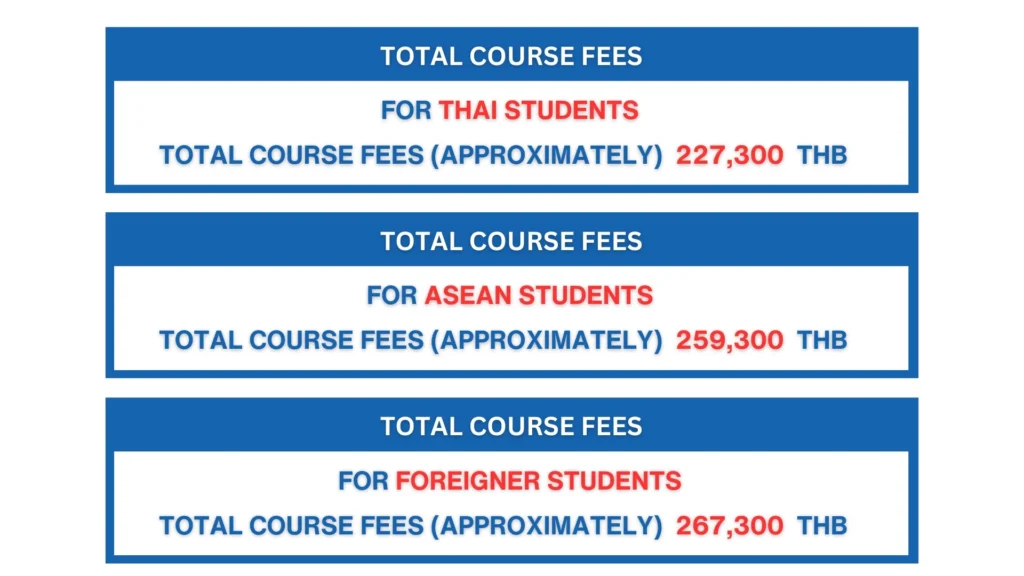
| 8. Total Cost (Approximate) | 227,300 THB (for Thai students) 259,300 บาท (for ASEAN students) 267,300 บาท (for Foreigner students) |
| More information | Click >> Announcement |
Testimonial
Contact
Address : 8th Floor, Boonchana Atthakorn Building,
118, Serithai Road, Klongchan,Bangkapi, Bangkok10240
Contact Person : Susopit : 02 – 727 – 3938
Tel : 02 – 727 – 3931 – 49
Fax : 02 – 374 – 3282, 02 – 375 – 3924
E-mail : susopit.p@gmail.com
Facebook : Amba NIDA
Question & Answer Accelerated MBA (Weekday Program)
AMBA Monday – Friday 9 am – 4 pm.
Bachelor’s Degree in any field. And English scores One of the following criteria. – TOEFL: 500 PBT, 173 CBT and 61 iBT – IELTS: 6.0 – NIDA TOEFL ITP: 500 – General English Test from NIDA: 500 Fully Qualified Apply Interviewed
Work experience is not required. I am interested in studying AMBA NIDA.
Total Cost Fees is 229,000 Baht. – Tuition Fees 180,600 Baht – Activities Fees 30,000 Baht – Other Fees 18,400 Baht
Letter of recommendation 2 copies from work or university